
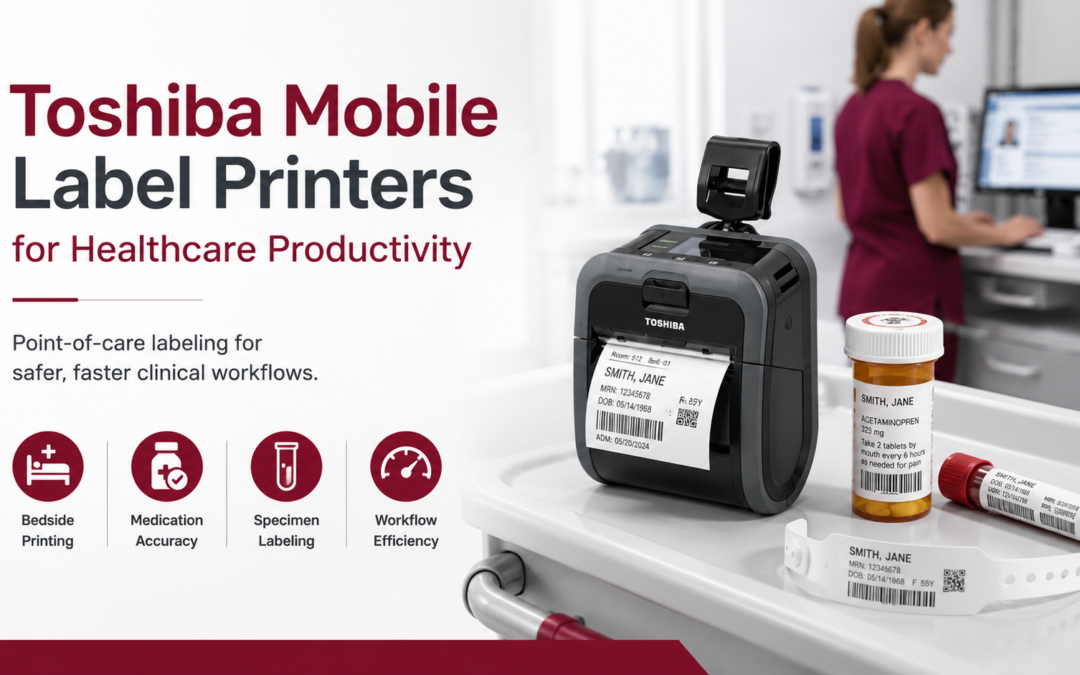
In Healthcare, Productivity Isn’t Optional—It’s Clinical
Hospitals and pharmacies do not measure efficiency by time alone. They also measure it by patient safety, medication accuracy, staff workload, throughput, and reimbursement.
However, many healthcare environments still rely on centralized printing workflows that slow teams down. Nurses, pharmacy staff, and lab teams often have to walk back and forth to print labels, verify information, and correct avoidable errors.
As a result, labeling becomes more than an administrative task. It becomes part of your clinical infrastructure.
That is why Toshiba mobile label printers can make such a difference. They bring label printing directly to the point of care, where accuracy and speed matter most.
The Shift: From Printing Stations to Point-of-Care Technology
Modern healthcare continues to move toward point-of-care workflows. Because of this shift, labeling needs to happen where care happens.
With Toshiba mobile label printers, your team can print:
- Patient wristbands
- Medication labels
- Specimen labels
- Pharmacy prescriptions
Instead of sending staff back to a central print station, mobile label printers allow labels to be printed at the bedside, pharmacy counter, or lab station. As a result, teams can reduce delays, avoid backtracking, and lower the risk of mismatched information.
The Measurable Impact on Productivity
Hospital leadership and pharmacy owners often ask the same question: does mobile label printing actually improve productivity?
The answer is yes. Barcode-driven workflows and mobile printing help healthcare teams reduce manual steps, improve accuracy, and streamline daily work. In addition, point-of-care labeling allows clinicians to spend more time on patient care and less time managing administrative tasks.
While results vary by facility, healthcare systems that use mobile and barcode-based workflows commonly see:
- Increased staff productivity through reduced walking time and task duplication
- Faster patient throughput in admissions, labs, and pharmacy
- Less rework caused by labeling mistakes
- Improved accuracy across medication and specimen workflows
For leadership, that means more patients served, fewer errors, and better use of clinical staff.
What That Means in Real Terms:
While results vary by facility, healthcare systems implementing mobile and barcode-based workflows commonly report:
- 15–30% increase in staff productivity (through reduced walking time and task duplication)
- Faster patient throughput in admissions, labs, and pharmacy
- Reduced rework and relabeling errors
Translation for leadership: More patients served, fewer errors, and better utilization of clinical staff.
Why Toshiba Mobile Printers Stand Out
Not all mobile printers are built for healthcare. Toshiba mobile label printers are designed for clinical environments where speed, accuracy, and reliability matter every day.
1. True Bedside Printing for Point-of-Care Accuracy
Toshiba mobile devices support on-the-spot labeling. Therefore, nurses and clinicians can print patient wristbands, medication labels, and specimen labels exactly where they need them. This helps ensure that medications, samples, and patient information match correctly in real time.
2. Seamless Integration with Clinical Systems
Toshiba printers can integrate with clinical systems and EHR platforms, including Cerner. Because of that, they become part of your standard healthcare workflow instead of another disconnected tool. This matters because healthcare teams need technology that fits into their day, not technology that creates extra steps.
3. Built for Pharmacy Precision
Pharmacy teams depend on accuracy. Toshiba mobile label printers support:
- Accurate dosage labeling
- Lot and expiration tracking
- Barcode compliance
- Prescription labeling
- Inventory control
As a result, pharmacies can improve medication safety while also supporting stronger tracking and compliance workflows.
4. Speed and Reliability in High-Volume Environments
Healthcare facilities generate large volumes of labels every year. Because delays can slow care delivery, mobile label printers must perform consistently. Toshiba printers deliver high-speed label output, durable labels, and reliable uptime in demanding healthcare environments. In addition, they help reduce the bottlenecks that often happen when too many departments depend on centralized printers.
5. Designed for Mobility, Not Just Portability
Toshiba mobile printers are lightweight, wearable, and built for long clinical shifts. More importantly, they are designed to move with your staff across departments. In healthcare, technology should support movement. It should not slow people down.
Use Cases That Directly Impact Operations
Toshiba mobile label printers can support several healthcare workflows.
Hospitals
- Bedside medication administration
- Patient ID wristbands
- Lab specimen collection
- Admissions workflows
- Discharge workflows
Pharmacies
- Prescription labeling
- Unit-dose packaging
- Inventory tracking
- Compliance labeling
- Medication safety workflows
Labs
- Sample labeling
- Specimen tracking
- Chain-of-custody accuracy
- Barcode-based identification
Together, these use cases help hospitals, pharmacies, and labs improve accuracy while keeping work moving.
From “Nice-to-Have” to Standard Clinical Infrastructure
Mobile label printing is no longer just a convenience. Instead, it is becoming standard clinical infrastructure in modern healthcare environments.
That is because Toshiba mobile label printers directly support:
- Patient safety initiatives
- Regulatory compliance
- Workflow automation
- Staff efficiency
- Medication accuracy
- Barcode compliance
In addition, barcode technology helps healthcare organizations reduce errors and improve patient safety outcomes. Mobile printing makes that system work in real time by placing accurate labeling directly into the clinical workflow.
The Financial Case for Hospital Administrators
Healthcare leaders must balance patient care, staffing challenges, compliance needs, and operating costs. Because of that, inefficient print environments can create more than a workflow problem. They can also create a financial problem.
Toshiba notes that large hospitals can print millions of pages each month, which can add up to significant annual printing expenses without proper control (Toshiba).
When healthcare organizations use Toshiba mobile printers as part of a broader workflow strategy, they can:
- Reduce labor inefficiencies
- Decrease costly errors
- Improve throughput
- Support faster billing cycles
- Reallocate staff to higher-value tasks
As a result, mobile label printing becomes more than an IT improvement. It supports operational and financial performance.
The Bottom Line
If your staff still walks back and forth to print labels, your organization may be losing time, adding risk, and limiting productivity. Toshiba mobile label printers bring labeling directly into the clinical workflow, where it belongs. In turn, healthcare teams can improve care delivery, increase staff productivity, and support safer patient outcomes.
Ready to Modernize Your Healthcare Workflow?
If you are evaluating ways to improve efficiency across your hospital, pharmacy, or lab operations, now is the time to look at mobile label printing.
Request a Free Workflow & Technology Assessment. We’ll show you where Toshiba mobile label printers fit into your environment and how quickly they can support measurable improvements.
Recent Comments