
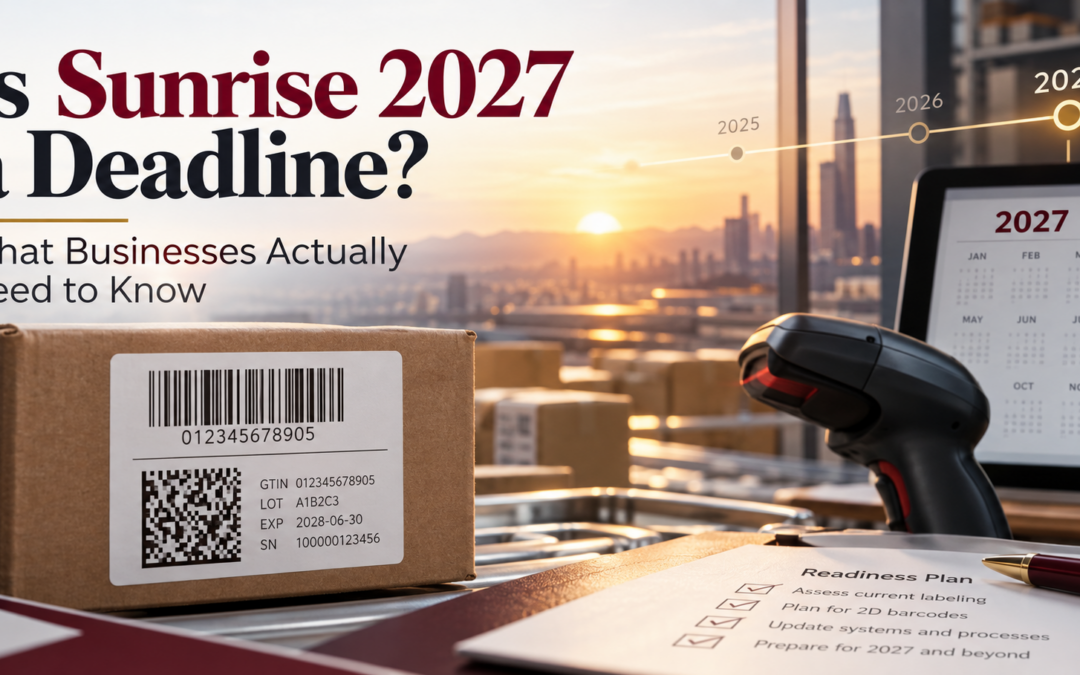
If your business uses barcodes for retail sales, manufacturing, inventory management, or distribution, you may have heard that everything needs to change by 2027. But is Sunrise 2027 really a deadline? And will your current barcodes and scanning equipment suddenly become obsolete?
The short answer is no. Sunrise 2027 is an important industry milestone, but it does not mean every business must replace its barcode systems by a specific date. However, that doesn’t mean businesses should ignore it. The retail industry is moving toward two-dimensional (2D) barcodes that can carry more information than traditional UPC barcodes. As this technology becomes more widely adopted, businesses will need to evaluate whether their current scanning, printing, and software systems can support it. Understanding what is changing—and what isn’t—can help your organization make informed technology decisions without unnecessary upgrades.
What Is Sunrise 2027?
Sunrise 2027 is an industry initiative coordinated by GS1, the global standards organization responsible for barcode standards used throughout retail and supply chains. The goal is for retail point-of-sale (POS) systems to be capable of scanning and processing GS1-standard 2D barcodes alongside traditional one-dimensional (1D) barcodes by the end of 2027. Traditional UPC barcodes have been used for decades to identify products at checkout. While they work well for basic product identification, they have limited capacity for additional information.
In comparison, 2D barcodes, such as GS1 DataMatrix and QR codes powered by GS1 standards, can support information including:
- Product identification
- Batch and lot numbers
- Expiration dates
- Serial numbers
- Product traceability information
- Links to additional product information
For example, a retailer may eventually use information encoded in a 2D barcode to identify products affected by a recall or recognize items approaching their expiration dates.
The key difference is that 2D barcodes can support more than basic product identification. They create opportunities for businesses to improve accuracy, visibility, and information sharing throughout their operations.
Is Sunrise 2027 a Mandatory Deadline?
This is where much of the confusion begins. Sunrise 2027 is not a blanket government mandate requiring every business to switch to 2D barcodes by December 31, 2027. Instead, it is an industry-established target for enabling retailers to accept and process 2D barcodes at checkout. GS1 describes the transition as a gradual process, recognizing that businesses will adopt new capabilities at different speeds.
Consequently, there are several important points businesses should understand:
- Traditional UPC barcodes are not disappearing in 2027. Retail systems are expected to continue accepting them during and after the transition.
- Businesses do not necessarily need to replace all existing labels. The appropriate approach depends on product packaging, customer expectations, and operational requirements.
- Not every business is directly affected by the retail POS milestone. Manufacturers, warehouses, and distributors may have different technology needs.
- Some businesses may face earlier customer requirements. Retail partners can establish their own barcode or labeling specifications.
- Not every 2D capability needs to be implemented by 2027. GS1 encourages organizations to take a phased approach.
In other words, the date is significant, but readiness depends on what your business does and how its products move through the supply chain.
What Does Sunrise 2027 Mean for Retailers?
Retailers are at the center of the Sunrise 2027 initiative because their checkout systems must be able to recognize and process the new barcodes. This involves more than purchasing a scanner capable of reading QR codes.
Retailers should evaluate whether their technology can:
- Read supported GS1 2D barcode formats.
- Extract the Global Trade Item Number (GTIN) used for product identification.
- Process that information correctly through their POS software.
- Continue scanning traditional UPC barcodes.
- Handle packages containing both traditional and 2D barcodes without checkout errors.
For example, a scanner might successfully recognize a QR code, but that doesn’t automatically mean the POS software can interpret the information required to complete a sale. Therefore, true readiness involves both hardware and software compatibility. Retailers should begin reviewing their existing equipment and speaking with their technology providers about 2D barcode support, especially when planning future equipment purchases.
What Does Sunrise 2027 Mean for Manufacturers and Product Brands?
For manufacturers and brands selling products through retail channels, Sunrise 2027 presents a different set of considerations. While retailers focus on checkout compatibility, manufacturers need to evaluate how product information is encoded and printed.
This could involve reviewing:
- Existing product labels and packaging
- Barcode printing equipment and software
- GTIN accuracy and product-data management
- Customer-specific labeling requirements
- Barcode placement, size, and print quality
- Opportunities to include more useful product information
For instance, a manufacturer producing consumer goods may want to include batch information or expiration dates in a 2D barcode to support product tracking. However, not every product needs the same data, and not every company will benefit from making identical changes. The goal should be to identify what information matters to your customers and operations before investing in new equipment or packaging. Businesses should also confirm that any proposed barcode formats meet applicable GS1 standards rather than assuming an ordinary QR code will automatically work at retail checkout.
What About Warehouses, Distributors, and Logistics Companies?
One of the most important distinctions is that the retail Sunrise 2027 milestone does not automatically apply to every barcode scanning environment. According to GS1 US guidance, general distribution, transportation, and logistics environments are not included in the retail Sunrise 2027 milestone. That means a warehouse using traditional barcodes for receiving, picking, packing, or shipping is not automatically required to replace those systems because of the 2027 retail target. However, there are still good reasons to evaluate 2D barcode technology.
For example, 2D barcodes can help organizations capture more information during a single scan, potentially improving:
- Inventory accuracy
- Product traceability
- Lot and batch tracking
- Shipping and receiving workflows
- Product identification
- Data collection efficiency
Additionally, customers and supply chain partners may introduce new labeling requirements as their systems evolve. For distributors and logistics providers, the better question may not be whether Sunrise 2027 requires an upgrade, but whether newer barcode technology could improve operations.
Seven Questions Every Business Should Ask Before 2027
Rather than rushing into a complete equipment replacement, businesses can begin with a practical review of their existing systems.
1. What types of barcodes are we currently using? Identify whether your operations rely on UPC, Code 128, GS1-128, QR codes, DataMatrix, or other formats.
2. Can our scanners read the 2D formats we may need? Not all scanning equipment supports every barcode format. Determine which scanners are already compatible and which may require upgrades.
3. Can our software process the information? Reading a barcode is only the first step. Your POS, inventory, warehouse management, or other business software must also interpret the data correctly.
4. Are our label printers capable of producing the required barcodes? Review the resolution, print quality, label materials, and software compatibility of your current printing equipment.
5. Have our customers or retail partners announced new requirements? Customer-specific labeling expectations may influence your timeline more directly than the general industry milestone.
6. Could 2D barcodes improve our current workflows? Consider whether additional data could help reduce manual entry, support traceability, or simplify inventory processes.
7. Can we make improvements gradually? A phased approach may allow your organization to replace aging equipment during normal technology refresh cycles rather than investing in an unnecessary overhaul.
By answering these questions now, businesses can develop a realistic readiness plan that aligns with their operations and budgets.
What Happens If Your Business Does Nothing Before 2027?
For some businesses, there may be no immediate operational impact. A company using traditional barcodes internally may be able to continue with its existing processes, particularly if customers and supply chain partners have not introduced new requirements. However, there are potential disadvantages to postponing the conversation indefinitely.
Businesses that wait until equipment fails or a major customer changes its labeling specifications may face rushed purchases, unexpected expenses, or operational disruptions. On the other hand, organizations that evaluate their systems early can make more informed decisions about future investments. The objective is not necessarily to replace technology today. It’s to avoid purchasing technology today that may not meet tomorrow’s needs. That distinction is especially important for businesses considering new barcode scanners, industrial label printers, or inventory management solutions.
How DDL Business Systems Can Help You Prepare
Preparing for changes in barcode technology doesn’t have to mean replacing every piece of equipment. At DDL Business Systems, we help organizations evaluate barcode printing and office technology solutions based on their actual business needs. Whether your company operates a manufacturing facility, warehouse, distribution center, or retail-related business, we can help you review your current labeling requirements and explore equipment options that support your operations. Our thermal and barcode printing solutions include Toshiba industrial label printers designed for demanding business environments.
We can help businesses consider:
- Thermal printer capabilities and print quality
- Existing barcode and label requirements
- Equipment compatibility considerations
- Labeling needs for manufacturing, inventory, and distribution
- Future equipment upgrades and technology planning
For businesses evaluating their next printer purchase, understanding both current requirements and future 2D barcode needs can help prevent unnecessary expenses.
Don’t Rush to Replace Your Barcodes. Start With a Readiness Review.
Sunrise 2027 represents a meaningful change in how businesses capture and share product information. But it is not a universal deadline requiring every company to overhaul its barcode systems.
- For retailers, the priority is preparing POS systems to process the new barcode formats.
- For manufacturers and product brands, the focus is evaluating packaging, labeling, and customer requirements.
- For warehouses and distributors, the opportunity is to determine whether 2D barcodes can improve existing workflows.
The smartest first step is understanding what your business actually needs. DDL Business Systems helps organizations across Northern Virginia, the Shenandoah Valley, and surrounding areas evaluate barcode printing and labeling technology.
Contact DDL Business Systems to discuss your current barcode printing equipment and future labeling needs.
Frequently Asked Questions About Sunrise 2027
Is Sunrise 2027 a government requirement?
No. Sunrise 2027 is an industry-led initiative coordinated by GS1, not a universal government mandate. Businesses should still review any separate regulatory or customer-specific labeling requirements that apply to their products.
Will UPC barcodes stop working in 2027?
No. GS1 states that traditional UPC barcodes will continue to be accepted after 2027. The transition is intended to allow retail systems to process both traditional and 2D barcodes.
Does every business need a new barcode scanner?
Not necessarily. Some existing scanners already support the relevant 2D formats. Businesses should verify both scanner capabilities and software compatibility before replacing equipment.
Are warehouses required to use 2D barcodes by 2027?
No. General distribution, transportation, and logistics operations are outside the retail Sunrise 2027 milestone. However, individual trading partners may introduce their own requirements.
Can an ordinary QR code be used at retail checkout?
Not automatically. The barcode must follow applicable GS1 standards and contain the product identification information needed by the retailer’s POS system.
Should businesses upgrade their barcode printers before 2027?
That depends on their current equipment, labeling requirements, and customer expectations. Reviewing barcode printing capabilities before making a new equipment investment is a practical starting point.
Recent Comments