Walk through almost any modern warehouse or distribution center and you will see barcodes everywhere. They identify cartons arriving at receiving. They help employees locate inventory. They follow pallets through staging areas. They appear on shipping labels before orders leave the building.
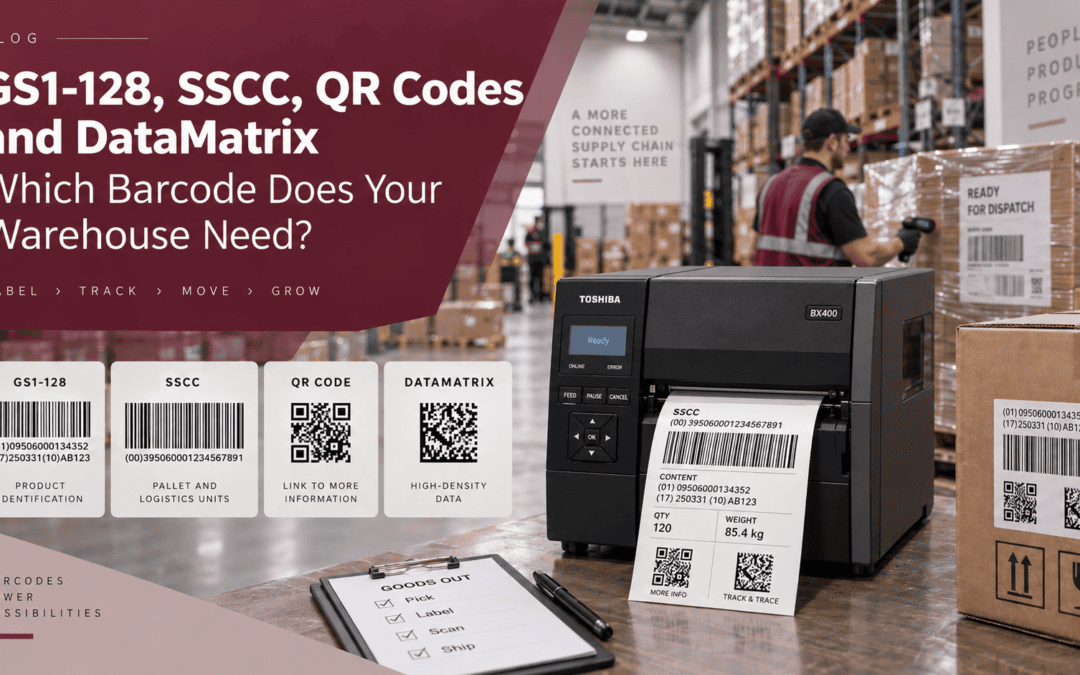
But not every barcode serves the same purpose. GS1-128, SSCC, QR Codes and DataMatrix are frequently discussed when businesses are evaluating warehouse labeling systems. Although these terms are sometimes used interchangeably, they actually describe different technologies and identifiers.
Choosing the right barcode depends on what you need to identify, what information needs to travel with the product or shipment, where the barcode will be scanned and what your warehouse management system needs to do with the information. Understanding those differences can help warehouses avoid scanning problems, improve traceability and prepare their labeling operations for the growing use of 2D barcodes.
First, Understand the Difference Between a Barcode and an Identifier
Before comparing barcode technologies, there is an important distinction to make. SSCC is not technically a barcode type. The Serial Shipping Container Code, or SSCC, is an identifier used to uniquely identify an individual logistics unit such as a pallet, case or parcel.
GS1 describes a logistics unit as goods grouped together for storage or transportation. Each logistics unit can be assigned its own SSCC so it can be tracked as it moves through the supply chain. GS1’s Logistic Label Guideline identifies the SSCC as the mandatory identifier for a GS1 logistics label.
The SSCC is normally encoded in a GS1-128 barcode on that logistics label. Think of it this way: SSCC = the identification number. GS1-128 = the barcode that carries that number on a GS1 logistics label.
That distinction becomes important when designing warehouse and shipping labels.
What Is GS1-128?
GS1-128 is a one-dimensional, or 1D, barcode widely used throughout logistics, distribution and manufacturing. Unlike a basic barcode that simply identifies an item, GS1-128 can contain several pieces of structured information. It does this through GS1 Application Identifiers, commonly called AIs. Application Identifiers tell the scanning system what the information immediately following them represents.
For example, a GS1-128 barcode can contain information relating to a product identifier, lot or batch number, expiration date, quantity or logistics-unit identifier. GS1 explains that Application Identifiers allow organizations throughout the supply chain to interpret barcode data consistently rather than relying on company-specific data formats.
When should a warehouse use GS1-128?
GS1-128 is particularly useful when products, cartons or pallets need to move between companies. A warehouse may use GS1-128 for receiving products from suppliers, identifying outer cases, creating customer-compliant shipping labels, tracking lot-controlled products or identifying pallets. GS1 specifically recommends GS1-128 for outer cases and logistics labels.
For many traditional warehouse and distribution applications, that makes GS1-128 one of the most important barcode formats to understand.
What Is an SSCC Barcode?
When someone refers to an “SSCC barcode,” they generally mean a GS1-128 barcode containing a Serial Shipping Container Code. An SSCC contains 18 digits and uniquely identifies a logistics unit.
That logistics unit could be one pallet containing 40 cartons, another pallet containing the same products or a mixed pallet containing multiple products. Each can receive its own unique SSCC. Instead of trying to fit every detail about the shipment into the barcode, the SSCC can act as the key that connects the physical pallet with information stored in warehouse, ERP or supply-chain systems.
GS1 notes that scanning the SSCC allows the physical movement of logistics units to be connected to electronic business information associated with those units. This supports processes such as automated receiving, shipment routing and cross-docking.
Example: Where SSCC makes sense
Imagine a distribution center preparing 25 pallets for a major retailer. Each pallet may contain different products and quantities. Instead of relying on employees to manually identify every product on every pallet during receiving, the supplier can assign each pallet an SSCC. The receiving warehouse scans the GS1-128 barcode containing the SSCC and connects that pallet with the associated shipment information.
That can make the SSCC especially valuable for pallet identification and business-to-business logistics.
What Is GS1 DataMatrix?
DataMatrix is a two-dimensional barcode made from small squares rather than the vertical bars used in traditional 1D barcodes. For GS1 applications, you will frequently see the term GS1 DataMatrix. The biggest advantage of DataMatrix is its ability to store relatively large amounts of information in a small physical area.
GS1 identifies several characteristics of GS1 DataMatrix, including its compact size, support for numeric and alphanumeric information and ability to be read from different orientations. That makes DataMatrix useful when label space is limited or when multiple pieces of information need to travel with an item. A GS1 DataMatrix could contain information such as a GTIN, serial number, batch or lot number and expiration date.
However, your scanning equipment matters. GS1 notes that systems reading GS1 DataMatrix require 2D imaging scanners that are properly configured to process the GS1 version of DataMatrix. A warehouse considering DataMatrix should therefore evaluate both its printers and its scanners.
What Is a QR Code?
QR Codes are another type of 2D barcode, but their best-known advantage is the ability to connect physical objects with digital information. Most smartphones can scan QR Codes directly using their cameras, which has helped make QR Codes familiar to consumers.
Within GS1 applications, QR Codes can also use GS1 Digital Link, allowing standardized product information to be represented in a web-compatible format. GS1 explains that QR Codes and Data Matrix using GS1 Digital Link can support traditional supply-chain information while also connecting users to web-based resources. GS1 also notes that QR Code is currently preferred for consumer engagement because mobile-device cameras can generally scan it directly.
That makes QR Codes particularly interesting when a business wants one barcode to support more than an internal warehouse workflow. For example, the same product could potentially connect employees or customers to product information, instructions, traceability information or other digital resources.
GS1-128 vs. SSCC vs. DataMatrix vs. QR Code
The easiest way to determine which one you need is to consider the job the barcode must perform.
| Technology | What It Is | Best Warehouse Uses | Key Consideration |
|---|---|---|---|
| GS1-128 | 1D barcode symbology | Cases, cartons, logistics labels, shipping | Excellent for structured supply-chain data |
| SSCC | Unique logistics-unit identifier | Pallets, shipping units, logistics units | Usually encoded in GS1-128 |
| GS1 DataMatrix | Compact 2D barcode | Small labels, serial numbers, lot/expiration data, item-level tracking | Requires 2D imaging scanners |
| QR Code | 2D barcode | Web-connected product information and GS1 Digital Link applications | Especially useful when digital/web access is needed |
There is no universal “best barcode.” The right choice depends on what the warehouse is trying to accomplish.
If You Are Labeling Pallets, Start with SSCC and GS1-128
For pallets and other logistics units moving between businesses, SSCC combined with GS1-128 remains especially important. GS1’s Logistic Label Guideline says each logistics unit should have a unique SSCC and identifies the SSCC as the mandatory element of the GS1 logistics label. This means warehouses shipping products to retailers, distributors or other trading partners should first determine whether those partners require GS1 logistics labels. Trading-partner requirements should always be reviewed before changing barcode formats.
If You Need More Information in Less Space, Consider DataMatrix
Sometimes a traditional linear barcode simply takes up too much room. That is where 2D barcodes become particularly useful. Because information is encoded vertically and horizontally, a 2D symbol can carry more information within a relatively compact footprint. DataMatrix can therefore make sense for small product labels, electronic components, healthcare products, serial-number tracking or products requiring lot and expiration information.
This can also affect printer selection. Applications involving very small labels, small text or high-density 2D barcodes may benefit from higher-resolution thermal printers that can maintain the detail needed for reliable scanning.
If You Want a Barcode to Connect to the Web, Consider QR Code
QR Codes are particularly useful when the barcode needs to serve both operational and digital purposes. For example, a QR Code might direct users to product documentation, installation instructions, safety information, warranty information, traceability records or other digital resources.
GS1 Digital Link extends this concept by allowing GS1 identifiers to be placed into a web-compatible structure. However, that does not mean warehouses should automatically replace every GS1-128 barcode with a QR Code. The barcode must still match the application, trading-partner requirements, scanners and software systems being used.
What About the Move Toward 2D Barcodes?
The barcode environment is changing. GS1 has been working with industry on broader adoption of next generation 2D barcodes, with 2027 serving as an important milestone for retail systems to be capable of processing these newer barcode formats alongside traditional barcodes.
For warehouses and manufacturers, however, this does not mean every existing barcode will suddenly disappear. Warehouses may continue using GS1-128 for logistics while beginning to encounter more DataMatrix and QR Codes on individual products and packaging. As a result, organizations planning new barcode systems should think beyond the printer itself.
They should evaluate whether their label software, warehouse management system, ERP system, printers, scanners and data structure can support both existing 1D workflows and emerging 2D barcode applications.
Your Barcode Printer Matters Too
Selecting the correct barcode format is only part of the equation. The barcode still has to be printed clearly enough for scanners to read it consistently. Problems such as insufficient contrast, incorrect barcode dimensions, damaged labels, poor printer calibration, improper placement and inadequate quiet zones can all affect barcode performance.
GS1 recommends checking factors including barcode size, quiet zones, contrast, symbol construction, barcode height and label condition. For logistics labels specifically, GS1 recommends regular printer checks and ongoing barcode-label verification after implementation. This becomes increasingly important in high-volume warehouse environments where thousands of labels may be printed every day. A barcode that works when a label format is first designed may not continue performing correctly if printheads become worn, printer settings change or different labels and ribbons are introduced.
Barcode Scanning and Barcode Verification Are Not the Same Thing
Another common mistake is assuming that a barcode is correct simply because a scanner can read it. A successful scan tells you that one scanner was able to decode the barcode under those particular conditions.
Barcode verification goes further by measuring the printed barcode against established quality standards. GS1 recommends using compliant barcode verifiers to measure symbol quality and references ISO/IEC standards for both linear and two-dimensional barcode verification. For companies shipping products to multiple warehouses, retailers or distribution partners, verification can help identify potential problems before labels leave the facility.
Which Barcode Does Your Warehouse Need?
For many warehouses, the answer will actually be more than one. A warehouse might use GS1-128 and SSCC for outbound pallets, traditional barcodes for internal inventory locations, GS1 DataMatrix for compact item-level identification and QR Codes for applications requiring access to digital information.
The important question is not simply: “Which barcode is newer?”
Instead, ask: What are we identifying, what information must be captured, who needs to scan it and what system needs to receive the information? Once those questions are answered, it becomes much easier to determine the appropriate barcode, printer resolution, label material, scanner and software configuration.
Preparing Your Warehouse for Modern Barcode Requirements
If your warehouse is replacing aging thermal printers, adding new distribution lines or preparing for expanded 2D barcode use, now is a good time to review the entire labeling workflow. DDL Business Systems helps warehouses, distribution centers and manufacturers evaluate industrial label-printing requirements including label dimensions, print volume, barcode types, resolution, thermal-transfer versus direct-thermal printing, labels, ribbons, software compatibility and existing printer environments.
The Toshiba BX400 Series supports industrial barcode and label-printing applications ranging from shipping and pallet labels to high-resolution 2D barcode applications. Rather than selecting an industrial printer based solely on speed or specifications, DDL can help evaluate how the printer will actually fit into your warehouse workflow.
Need help determining whether your existing label printers are ready for GS1-128, SSCC or emerging 2D barcode requirements?
Schedule an Industrial Label Printer Assessment with DDL Business Systems and let us review your existing printers, labels, barcode requirements and workflow.
Recent Comments