
What Happens If Your Business Data Disappears Tomorrow?
Most businesses believe their data is safe until something goes wrong. A cyberattack locks files. A server crashes. An employee accidentally deletes an important folder. Suddenly, your team can’t access the systems they need, and work comes to a stop.
And here’s the reality:
Even a few hours of downtime can cost a business thousands of dollars. For some organizations, it can damage client trust, delay operations, and create serious financial strain. However, for some businesses, it can cost everything. That’s why backup and disaster recovery (BDR) is no longer a “nice-to-have.” Today, every business needs a reliable plan to protect data, restore systems, and keep operations moving.
What Is Backup and Disaster Recovery (BDR)?
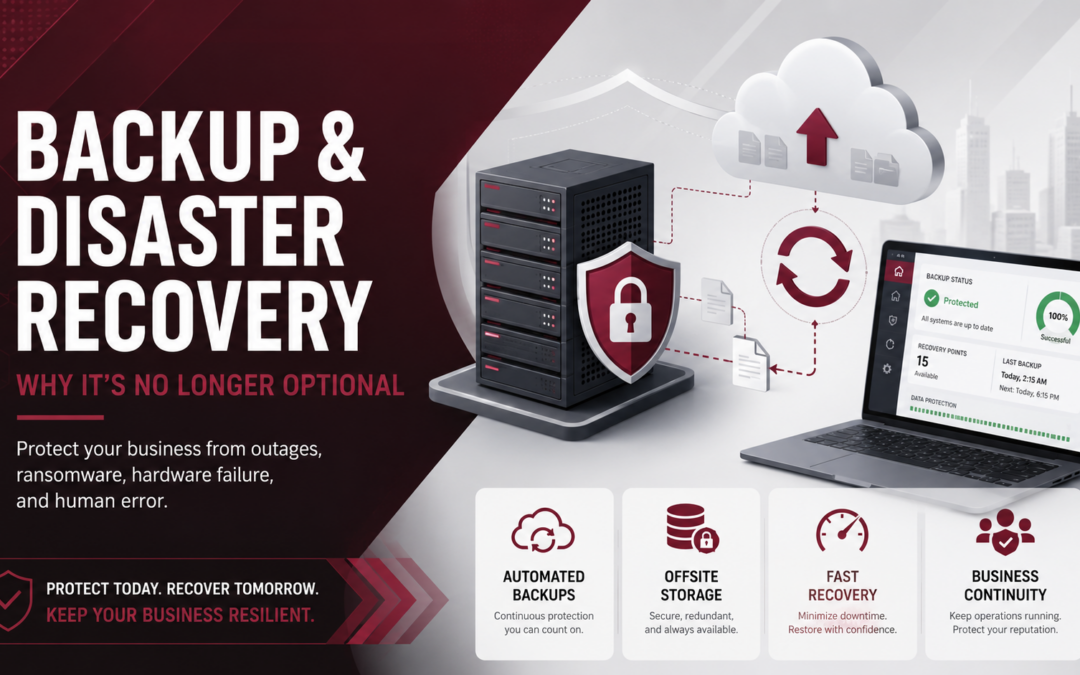
Backup and Disaster Recovery, often called BDR, helps your business recover when data loss, cyberattacks, system failures, or outages occur. A strong BDR strategy gives your team a clear way to restore files, recover systems, and resume operations as quickly as possible.
In simple terms:
Backup = copies of your data
Disaster Recovery = the plan to restore systems and resume work
Many businesses have some type of backup in place. However, a backup by itself does not guarantee fast recovery. That gap creates risk.
Why Backup Alone Isn’t Enough
At first, having backups may sound like enough protection. However, backups only solve part of the problem.
Businesses often run into trouble when:
- Backups are outdated or incomplete
- Data takes too long to restore
- Systems cannot come back online quickly
- No clear recovery process exists
- No one tests the backup system regularly
As a result, a company may still face extended downtime, even when backup files exist.
In other words, you may have your data, but your business still may not be able to operate.
The Real Risks of Not Having a BDR Plan
Without a proper backup and disaster recovery strategy, your business faces several avoidable risks.
- Cyberattacks (Ransomware): Cybercriminals do not just steal data. They often lock files and demand payment. Without clean backups and a fast recovery process, your business may lose access to critical information.
- Hardware Failures: Servers, computers, and storage devices eventually fail. Because of that, recovery speed matters. A strong BDR plan helps your business restore systems before downtime causes bigger problems.
- Human Error: Employees can accidentally delete files, overwrite documents, or misconfigure systems. Fortunately, a reliable backup and disaster recovery plan can make those mistakes easier to reverse.
- Natural Disasters & Power Outages: Storms, fires, floods, and power outages can take systems offline without warning. When businesses prepare in advance, they can recover faster and reduce operational disruption.
What a Strong Backup and Disaster Recovery Solution Looks Like
Not all BDR solutions offer the same level of protection. A strong backup and disaster recovery solution should include:
- Automated Backups: Your system backs up data regularly without relying on manual steps.
- Secure, Offsite Storage: Your business stores backup data in the cloud or another secure location, so one local issue does not put everything at risk.
- Fast Recovery Time (RTO): Your team can restore systems quickly after a disruption.
- Minimal Data Loss (RPO): Frequent backups help reduce the amount of work your business could lose.
- Full System Restoration: A complete BDR plan restores more than files. It also helps recover systems, applications, and workflows.
Together, these pieces help your business recover with less stress and less downtime.
How Backup & Disaster Recovery Impacts Your Business
When businesses implement BDR correctly, they do more than protect data. They also improve day-to-day resilience.
A strong BDR strategy can:
- Reduce Downtime: Your team gets back to work faster after an outage or cyberattack.
- Protect Revenue: Less downtime means fewer missed opportunities and fewer service delays.
- Strengthen Security: Your business prepares for ransomware, data loss, and system failures.
- Build Client Confidence: Customers trust companies that take data protection seriously.
Because of this, backup and disaster recovery should be part of your overall business continuity plan.
Common Mistakes Businesses Make
Even well-intentioned businesses often miss important BDR details. The most common mistakes include:
- Assuming their IT provider “has it covered”
- Relying only on local backups
- Failing to test the recovery process
- Not knowing how long recovery actually takes
- Waiting until something breaks to look for gaps
Unfortunately, many companies discover these problems during an emergency. By then, recovery becomes harder, slower, and more expensive.
How to Know If Your Business Is at Risk
A few simple questions can reveal whether your backup and disaster recovery plan needs attention.
Ask yourself:
- How long would it take to restore operations today?
- When did your last successful backup run?
- Can you recover full systems or only individual files?
- Has anyone tested your recovery process recently?
- Do you have a documented disaster recovery plan?
If you feel unsure about any of these answers, your business may have a backup and disaster recovery gap.
The Smarter Approach: Proactive Protection
The businesses that recover fastest usually plan before something goes wrong.
Instead of reacting to problems, they:
- Monitor backups continuously
- Test recovery processes regularly
- Use secure cloud-based redundancy
- Document recovery steps
- Work with a partner who verifies that the system actually works
As a result, these businesses can respond faster when disruption happens. More importantly, they reduce panic because they already know what to do.
Final Thought: It’s Not About If—It’s About When
Every business relies on data. However, not every business can recover quickly after losing it. Backup and disaster recovery is not about fear. It is about control.
- Control over your data.
- Control over your downtime.
- Control over your business continuity.
With the right BDR strategy in place, your business can face disruptions with a clear recovery plan instead of scrambling after the damage is done.
Get a Free Technology Assessment
If you’re not 100% confident in your backup and recovery setup, it’s worth taking a closer look.
Recent Comments