
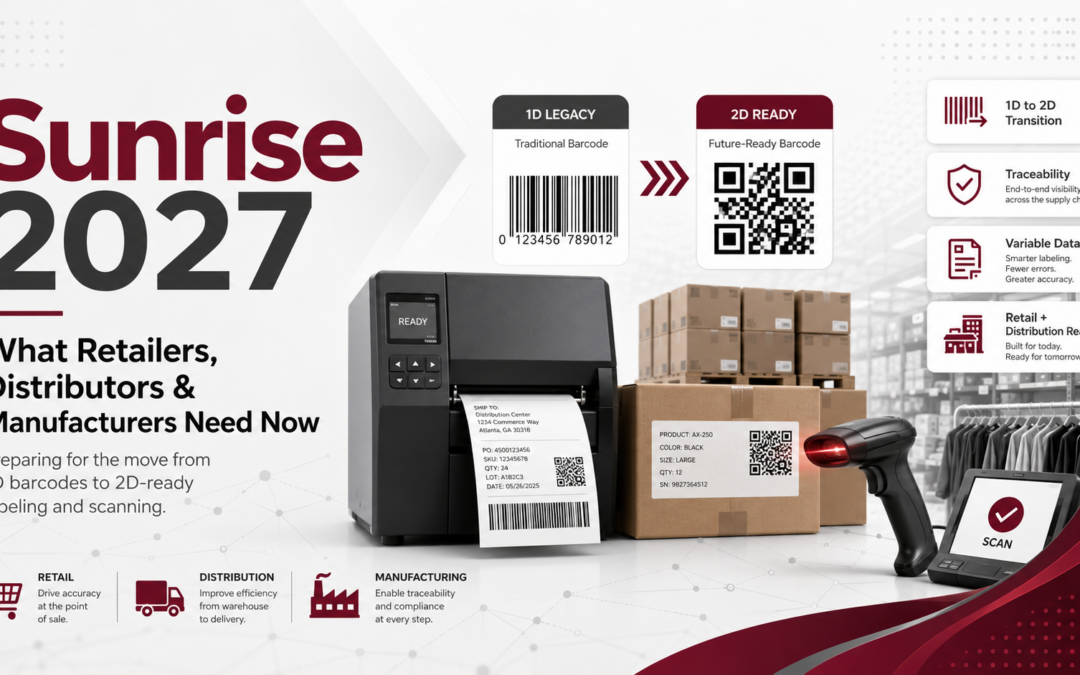
The Clock Is Ticking on Sunrise 2027
Sunrise 2027 is getting closer, but businesses should think of it as a readiness milestone rather than a universal compliance deadline. The 2027 milestone focuses specifically on helping retailers ensure their point-of-sale systems can scan and process 2D barcodes. Traditional 1D UPC barcodes are not expected to disappear overnight, and many organizations will operate in an environment where 1D and 2D barcodes coexist during the transition. For manufacturers, distributors, warehouses and logistics providers, the impact may be more indirect—but it is still important.
As retailers and brands adopt more 2D barcodes, those codes will increasingly move through manufacturing, distribution and fulfillment environments. That means businesses should begin evaluating whether their existing labeling and scanning systems are ready to support the changing requirements of customers and trading partners. That review should go beyond the barcode printer itself.
Businesses may need to consider:
- Whether current scanners can read the required 2D barcode formats
- Whether label printers can consistently produce high-quality 2D codes
- Whether label-design software supports the necessary barcode types and variable data
- Whether ERP or warehouse management systems can capture and use the information encoded in those barcodes
- Whether current workflows can adapt as customer or retailer labeling requirements change
The question is not necessarily:
“Do we have to replace everything before 2027?”
A better question is: “Is our current labeling and scanning environment ready for where our customers and trading partners are going?” Evaluating that now gives businesses time to identify gaps, test equipment and workflows, and make upgrades where they are actually needed—rather than reacting after requirements begin to change.
Why Sunrise 2027 Matters (More Than You Think)
At first, Sunrise 2027 may sound like a simple barcode change. However, it is really about building a smarter, more connected supply chain. 2D barcodes can hold more data in less space. For example, they can include batch numbers, expiration dates, serial numbers, URLs, and product details. As a result, businesses can improve traceability, simplify recalls, support compliance, and create better customer experiences.
In addition, consumer demand is helping drive this shift. Shoppers increasingly want product details, transparency, and easy access to information.
What 2D Barcodes Enable:
- More data in less space (batch, expiration, serial numbers, URLs)
- End-to-end traceability across the supply chain
- Faster, more accurate recalls with batch-level tracking
- Consumer engagement via QR codes and digital experiences
- Improved transparency and compliance
In fact, consumer demand is already driving this shift:
- 79% of shoppers are more likely to buy products with QR-accessible info
- 62% are willing to pay more for products with detailed transparency
Therefore, 2D barcodes are becoming more than a technical requirement. They are becoming a competitive advantage.
The Real Problem: Legacy Labeling Infrastructure
Here’s where many businesses get stuck. Retailers, distributors, and manufacturers often rely on older labeling systems that were not designed for dynamic, data-rich 2D barcodes. In many cases, they are still using 10+ year-old printer fleets, hard-coded label templates, and systems that require IT support for simple updates.
Because of that, simply replacing a printer may not solve the problem. The real challenge is how labels are created, managed, updated, and printed across the business.
Many retailers and distributors are still running:
- 10+ year-old printer fleets
- Hard-coded label templates
- Systems that require IT intervention for simple updates
These environments weren’t built for dynamic, data-rich 2D barcodes.
That is why Sunrise 2027 preparation should start with a full look at your labeling process, not just your equipment. And simply replacing a printer doesn’t fix the issue— The real challenge is how labels are created, managed, and printed across systems.
How Sunrise 2027 Impacts Retailers & Distributors
Sunrise 2027 will affect several areas of business operations.
- Point-of-Sale Changes: Retailers will need scanners and systems that can read 2D barcodes alongside traditional UPCs. As a result, point-of-sale readiness will become an important part of the transition.
- Real-Time Labeling Requirements: Distributors will need more flexible, on-demand label printing. For example, distributors will need on-demand, variable data printing for lot numbers, expiration dates, and serialization data may need to change from one product or shipment to the next.
- Supply Chain Visibility Expectations: Because 2D barcodes support better traceability, supply chain partners will expect more accurate and transparent product data. Therefore, businesses that cannot provide that information may face delays or compliance issues.
- Equipment Upgrades Are Coming: Many businesses will need to upgrade labeling or coding equipment before 2027. In fact, according to industry research, 88% of manufacturers plan to invest in new labeling or coding equipment by 2027. However, waiting too long could lead to rushed decisions, higher costs, and unnecessary disruption.
The Opportunity: Get Ahead Instead of Catching Up
Although Sunrise 2027 creates new requirements, it also creates an opportunity. Businesses that act early can streamline operations, improve inventory accuracy, enhance customer experience, and build trust through better transparency.
In other words, this is not just about compliance. With the right approach, Sunrise 2027 can help your business modernize labeling, reduce manual work, and improve supply chain performance such as:
- Streamline operations
- Improve inventory accuracy
- Enhance customer experience
- Win with better transparency and trust
Sunrise 2027 isn’t just compliance—it’s a growth opportunity.
How Toshiba BX Series Solves the Sunrise 2027 Challenge
This is where Toshiba’s BX Series industrial printers can help. They are built to support businesses as they transition to 2D barcode printing without creating unnecessary disruption.
Key Advantages of BX Series:
- Native 2D Barcode Support: Toshiba BX Series printers can print QR codes, DataMatrix, and GS1 Digital Link labels. As a result, businesses can prepare for Sunrise 2027 from day one.
- Backward Compatibility: The BX Series supports legacy printer languages like ZPL. Therefore, businesses may not need to rebuild existing workflows from scratch.
- Fewer IT Challenges: Print Data Converter allows businesses to add 2D barcodes to existing labels. In addition, native PDF printing helps reduce complex driver dependency.
- Industrial-Grade Performance: The BX Series is built for high-volume environments such as:
- Distribution centers
- Retail backrooms
- Manufacturing lines
- A Smoother Transition: Most importantly, the BX Series allows businesses to run both 1D and 2D barcodes during the transition. Because of this flexibility, you can upgrade at a manageable pace instead of waiting until pressure builds.
Why This Matters for Your Business
Let’s simplify it. Without the right solution your business may face:
- Costly system updates
- IT bottlenecks
- Slow label changes
- Operational disruptions
However, with Toshiba BX Series printers, you can modernize your labeling process, reduce IT dependency, and stay ahead of retailer and supply chain requirements. As a result, your business gains more than compliance. You gain a stronger, more flexible labeling environment that supports future growth.
Don’t Wait Until 2027
Sunrise 2027 may sound far away. However, supply chains, retailers, and competitors are already preparing. That means businesses should start evaluating their current labeling systems now. The companies that prepare early will have more time to test, train, upgrade, and adjust before the deadline creates pressure.
To stay ahead, focus on three steps:
- Start early
- Upgrade strategically
- Choose solutions that minimize disruption
Final Takeaway
Sunrise 2027 is reshaping how products move, how they are tracked, and how customers interact with them. For retailers, distributors, and manufacturers, the question is no longer, “Will this impact us?”
The better question is, “Are we ready?” Not sure if your current labeling setup is Sunrise-ready?
Request a Free Technology Assessment. We’ll show you where your risks are, what needs to change, and how to transition without disrupting your business.
Recent Comments