
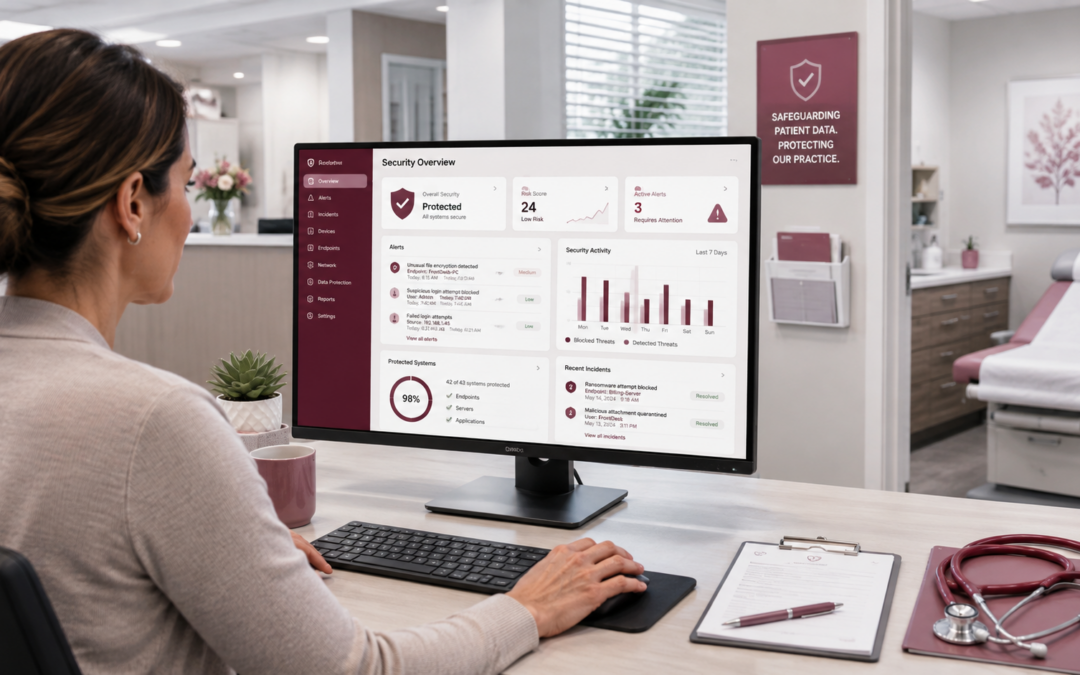
A ransomware attack at a healthcare organization can affect much more than computers. If employees cannot access patient records, scheduling systems, email, billing applications, shared files, printers, or other connected technology, normal operations can quickly become difficult. Moreover, attackers increasingly combine encryption with data theft. Therefore, healthcare organizations must think about ransomware as both a cybersecurity threat and a business-continuity risk.
The latest data reinforces that concern. According to the 2026 Verizon Data Breach Investigations Report, Verizon analyzed 1,492 healthcare security incidents, including 1,438 incidents with confirmed data disclosure. System Intrusion remained healthcare’s leading breach pattern for the second consecutive year, and Verizon specifically describes healthcare as facing ransomware-driven system intrusions alongside persistent human error.
In addition, 81% of healthcare breaches in Verizon’s dataset involved external threat actors, while 99% involved a financial motive. Vulnerability exploitation accounted for 20% of initial access, phishing for 14%, and credential abuse for 11%. Meanwhile, the human element appeared in 54% of healthcare breaches, and third parties were involved in 32%.
For physician practices, clinics, specialty providers and other healthcare organizations, the message is clear: ransomware preparation should happen before an attacker gets into the network.
Quick Answer: What Is Healthcare Ransomware?
Healthcare ransomware is malicious software or an extortion attack designed to deny access to systems or data, often by encrypting files, while attackers demand payment. Modern ransomware attacks may also involve stealing information before systems are encrypted, creating risks to patient information as well as healthcare operations.
HHS describes ransomware as malware that typically denies users access to their data through encryption and notes that some ransomware also destroys or exfiltrates information.
Why Ransomware Can Be Especially Disruptive in Healthcare
Every business depends on technology. However, healthcare organizations often depend on technology while simultaneously delivering time-sensitive services. For example, employees may need immediate access to patient records, appointment schedules, diagnostic information, billing platforms, prescriptions, insurance information, communication systems and document workflows. Consequently, losing access to multiple systems at once can create operational problems very quickly.
HHS has previously warned that cyberattacks against healthcare organizations can disrupt operations and patient care, including appointment cancellations, delayed procedures, patient diversion and extended outages. Meanwhile, the HIPAA Security Rule requires regulated organizations to implement appropriate administrative, physical and technical safeguards to protect the confidentiality, integrity and availability of electronic protected health information, or ePHI.
Therefore, ransomware protection should not be treated simply as an antivirus project. Instead, it should be part of the organization’s larger technology, security, compliance and business-continuity strategy.
1. Start With a Complete Security Risk Analysis
You cannot adequately protect technology that you do not know exists. For that reason, healthcare organizations should begin by identifying systems, devices, applications and vendors that create, receive, maintain or transmit ePHI.
That review should extend beyond the EHR. For example, consider employee computers, Microsoft 365 accounts, file servers, cloud platforms, backup systems, mobile devices, remote-access tools, printers, copiers, scanners and third-party applications. The HIPAA Security Rule requires an accurate and thorough assessment of potential risks and vulnerabilities to ePHI. In addition, HHS emphasizes that risk analysis influences the security measures an organization ultimately chooses to implement.
DDL discusses several easily overlooked technologies in HIPAA Compliance Beyond the EHR: 9 Office Technology Risks Healthcare Practices Often Overlook. For example, connected printers, scanning workflows, shared accounts, phone systems and outside technology vendors can all become part of the larger security picture.
Transition to action: First, identify your technology. Next, identify where sensitive information travels. Finally, determine which vulnerabilities could interrupt operations or expose ePHI.
2. Patch and Harden Systems Before Attackers Exploit Them
Ransomware attackers do not always need someone to click a malicious email. In fact, Verizon’s 2026 healthcare data show that exploitation of vulnerabilities was the leading initial access method among the three specifically reported healthcare vectors, at 20%. Therefore, healthcare organizations should maintain a disciplined process for installing security updates, retiring unsupported software and reviewing vulnerable systems. Additionally, security teams should pay attention to operating-system configurations, unnecessary services, remote-access software and applications that may have been installed years ago but are no longer required.
HHS’s January 2026 cybersecurity guidance specifically recommends system hardening, which can include patching known vulnerabilities, disable unnecessary software and services, and properly configuring security controls. Printers and multifunction devices should not be forgotten, either. Modern office equipment may connect to networks, store information and communicate with cloud platforms. Therefore, firmware, administrator passwords and device configurations should also be included in the organization’s security-management process. DDL’s HIPAA-Compliant Printing guide explains why printers should be treated as part of the healthcare technology environment.
3. Strengthen Identity Security with MFA and Better Access Controls
A stolen password can give an attacker a foothold inside an organization. Consequently, password protection alone is no longer a strong enough strategy for many critical healthcare systems. Multifactor authentication, or MFA, adds another verification step before a user can access an account. Therefore, even when an attacker obtains a password, the additional authentication requirement can create another barrier.
HHS notes that an organization’s risk analysis may determine MFA is necessary to sufficiently reduce unauthorized-access risk. Furthermore, HHS cybersecurity guidance addresses authentication, access controls and security baselines as part of protecting ePHI. Healthcare organizations should also review administrative privileges. Employees generally should not have more access than their jobs require. Similarly, accounts belonging to former employees should be disabled promptly, and shared logins should be minimized whenever possible.
4. Maintain Backups—and Make Sure You Can Actually Restore Them
Having a backup and being able to recover from a backup are not the same thing. Unfortunately, an organization may discover that backups are incomplete, corrupted, outdated or accessible to the ransomware attacker only after an incident occurs. Therefore, backup strategies should include both frequent backups and regular restoration testing.
HHS ransomware guidance specifically states that maintaining frequent backups and ensuring data can be recovered from those backups are crucial to ransomware recovery. HHS also recommends periodically testing restorations and considering offline backups because some ransomware can disrupt online backup systems. In addition, healthcare organizations should determine how quickly critical systems must be restored. A billing archive and a patient scheduling system, for example, may have very different recovery priorities.
Ultimately, the question should not simply be, “Do we have a backup?” A better question is, “If ransomware hit us tonight, how quickly could we restore the systems our employees need tomorrow morning?”
5. Use Network Segmentation to Limit How Far an Attack Can Spread
Cybersecurity is not only about keeping attackers out. It is also about limiting what happens if they get in. Network segmentation separates parts of an organization’s technology environment so that one compromised device does not necessarily give an attacker unrestricted access to everything else. For example, organizations may consider separating employee workstations, servers, guest Wi-Fi, printers, medical devices, administrative systems and backup environments based on their risk assessment and operational needs.
HHS’s proposed update to the HIPAA Security Rule specifically identifies network segmentation as an important cybersecurity measure, although the cybersecurity rulemaking remains a proposal rather than a finalized replacement for the current Security Rule. Meanwhile, HHS’s healthcare cybersecurity resources and CISA guidance also emphasize resilient system design, access protection and preparation for ransomware incidents.
6. Train Employees to Recognize Ransomware Entry Points
Technology can block many attacks. However, employees remain an important part of the defense. Healthcare employees receive emails from patients, vendors, insurers, pharmacies, laboratories, coworkers and other organizations every day. Consequently, a fraudulent message can be difficult to distinguish from legitimate communication.
Furthermore, phishing is no longer limited to email. Attackers may use text messages, phone calls, fake Microsoft 365 login screens and fraudulent document-sharing notifications. Verizon found that the human element appeared in 54% of healthcare breaches analyzed for its 2026 report. Therefore, security awareness should move beyond a once-a-year compliance presentation. Employees need practical examples of what they are likely to encounter. DDL’s Security Awareness Training focuses on phishing, fake login pages, credential theft and social engineering, along with phishing simulations and ongoing education.
Regular training can help employees recognize suspicious behavior. More importantly, employees should know exactly how and where to report something suspicious before a potential compromise spreads.
7. Review Third-Party Vendors and Remote Access
Healthcare technology environments rarely operate independently. Instead, organizations may rely on outside companies for billing, EHR support, cloud applications, IT services, phone systems, document storage, backup, medical equipment, printer service and many other functions.
That dependence can create additional security exposure. The 2026 Verizon DBIR found third-party involvement in 32% of healthcare breaches in its dataset. Therefore, healthcare practices should understand which vendors can access systems or ePHI, whether remote access is required, how accounts are secured, what security controls vendors use and how incidents will be reported.
Where applicable, healthcare organizations should also determine whether a Business Associate Agreement is required. HHS states that the HIPAA Security Rule includes BAA requirements when a business associate creates, receives, maintains or transmits ePHI on behalf of a covered entity.
Most importantly, vendor access should not remain active indefinitely simply because it was convenient during an installation years ago.
8. Build a Ransomware Response and Downtime Plan Before You Need It
One of the worst times to decide how to respond to ransomware is while ransomware is already spreading. Therefore, healthcare organizations should create documented incident-response procedures that identify who make decisions, who contacts technology vendors, how affected devices will be isolated, how employees will continue working, how backups will be restored and how communication will be handled.
The CISA StopRansomware Guide provides guidance for reducing ransomware risk and responding to incidents. Similarly, HHS guidance says healthcare organizations should have procedures to detect ransomware, contain its spread, eradicate it, restore data and conduct post-incident analysis. HIPAA also requires covered entities and business associates to maintain security incident procedures.
A healthcare downtime plan should also address basic operational questions. For instance, how will employees check in patients? How will clinicians access essential information? How will staff communicate? Which phone numbers should employees call? What happens if email is unavailable?
As a result, ransomware planning becomes more than cybersecurity. It becomes business continuity planning for patient care.
Does a Ransomware Attack Automatically Mean a HIPAA Breach?
A ransomware infection is a security incident under the HIPAA Security Rule. However, determining the organization’s breach-notification obligations requires a fact-specific analysis.
HHS guidance explains that when ransomware encrypts ePHI, a breach is presumed unless the covered entity or business associate can demonstrate through the required risk assessment that there is a low probability the PHI was compromised. Organizations should involve appropriate legal, compliance and cybersecurity professionals when making that determination. Therefore, healthcare practices should not wait until an incident occurs to determine who will handle technical investigation, legal review, HIPAA analysis and notification decisions.
Important: This article provides general cybersecurity and technology information and should not be considered legal or HIPAA compliance advice. Organizations should consult qualified legal and compliance professionals regarding their specific obligations.
Ransomware Protection Requires More Than One Security Tool
There is no single product that can eliminate ransomware risk. Instead, stronger healthcare cybersecurity comes from multiple layers working together: risk analysis, patching, endpoint protection, MFA, backups, network security, employee training, vendor management, monitoring and incident-response planning.
Moreover, healthcare organizations should consider the entire office technology environment—not simply their EHR. Printers, scanners, employee computers, cloud applications, email, document systems and communication platforms may all interact with sensitive information. Consequently, each should be considered as part of the organization’s overall cybersecurity strategy.
Healthcare organizations interested in reviewing the broader technology environment can also explore DDL’s Healthcare Technology Solutions and Managed IT Services. DDL’s healthcare services focus on helping physician practices, clinics, specialty providers and other healthcare organizations simplify and support the technology used in daily operations.
Is Your Healthcare Organization Prepared for Ransomware?
Ransomware preparation does not have to begin with a massive cybersecurity project. Instead, begin by identifying your most critical systems, understanding where sensitive information is stored, reviewing vulnerabilities and determining what would happen if those systems suddenly became unavailable. From there, your organization can prioritize improvements based on actual business and security risk.
DDL Business Systems can help evaluate your IT environment, cybersecurity risks, employee security awareness, backup and recovery strategy, connected office technology and other potential vulnerabilities. Schedule a Free IT Assessment to identify where your technology environment may need additional protection.
Healthcare organizations in Winchester and Frederick County can also explore DDL’s Winchester managed IT services for cybersecurity, backup and recovery, endpoint protection and ongoing IT management
Recent Comments