
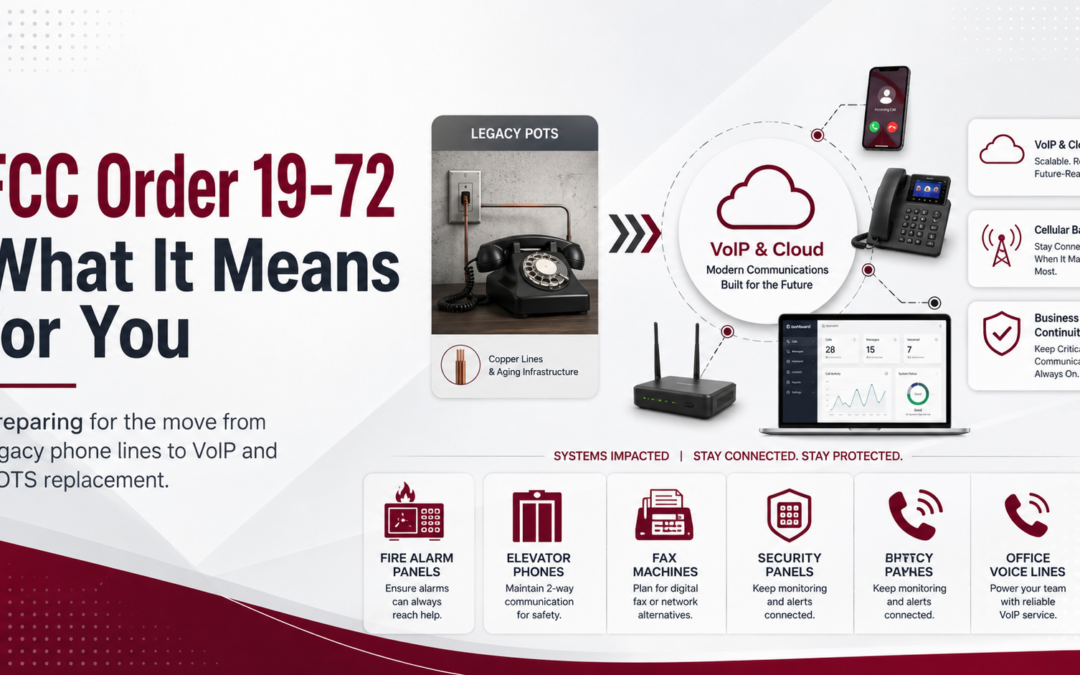
If you’ve heard that “POTS (Plain Old Telephone System) lines are going away” and wondered what that actually means for your business, you’re not alone. Many organizations still rely on traditional copper phone lines for fire alarms, elevator phones, fax machines, security panels, and legacy voice lines.
FCC Order 19-72, more precisely FCC Forbearance Order 19-72A1, did not make analog-dependent systems illegal. However, it did help move the telecom industry away from legacy copper infrastructure by reducing certain regulatory requirements tied to older phone networks. The FCC has also continued modernizing unbundling and resale rules to support technology transitions and next-generation networks (FCC fact sheet).
As a result, telecom providers are actively retiring, converting, or reducing support for traditional copper-based phone lines. Therefore, businesses now need to look closely at any system that still depends on a true analog connection. In simple terms, your equipment may still work. However, the phone line behind it may not be reliable long-term.
So, what does that mean for your day-to-day operations? Let’s break it down.
First: What’s actually changing?
Your equipment is usually not the main issue. Your phone line is. For decades, older systems plugged into a standard analog phone jack, often called a POTS line. That copper connection provided dial tone, signaling, and reliable communication in a straightforward way.
Today, however, carriers are replacing or retiring copper lines in favor of fiber, cellular, and IP-based networks. Because of this shift, a system that works today may still face problems later if the underlying service changes or disappears.
That is why businesses should not wait until a line fails. Instead, they should identify which systems still depend on copper and create a transition plan before service becomes unreliable.
Systems most affected
Several business systems still depend on traditional analog phone service. The most common include:
- Fire alarm panels
- Elevator emergency phones
- Fax machines
- Security and intrusion panels
- Legacy analog voice lines
Some of these systems support daily business operations. Others support life safety. Either way, they share the same risk: they rely on aging copper phone infrastructure.
Because of that, businesses should review these systems now and determine whether each one needs a POTS replacement, cellular communicator, VoIP solution, or cloud-based alternative.
The good news: you don’t have to replace everything
In most cases, businesses do not need to rip out all of their existing equipment. Instead, they need to replace the way that equipment connects.
Think of it this way:
You are upgrading the communication pathway, not necessarily the equipment.
That distinction matters. For example, a fire alarm panel, elevator phone, or security system may still perform its job well. However, it may need a new connection method so it can continue communicating reliably as copper lines go away.
How businesses are replacing analog lines today
Businesses typically use three main approaches to replace legacy analog phone lines. The right choice depends on the system, compliance needs, reliability requirements, and available connectivity.
1. POTS replacement devices (common for legacy systems)
POTS replacement devices are onsite adapters that simulate an analog phone line while using modern internet or cellular networks behind the scenes.
In other words, your existing equipment can often plug in the same way it did before, but the copper line is no longer required.
Businesses often use POTS replacement devices for:
- Fire alarm panels
- Elevator phones
- Security systems
- Some fax machines
- Legacy analog lines
For many organizations, this creates a practical bridge between old equipment and modern network infrastructure.
2. Cellular communicators (for life-safety systems)
For life-safety systems, many organizations are moving to dedicated cellular communicators. This option is especially common for fire alarm systems and elevator emergency phones.
Cellular communicators can help businesses reduce dependence on copper infrastructure while supporting supervised communication and monitoring. In addition, they often align better with modern safety expectations when properly installed and configured.
Because these systems affect safety and compliance, businesses should always work with qualified providers and confirm local code requirements before making changes.
3. VoIP and cloud-based solutions (for everyday communications)
For everyday business communications, many organizations are moving from legacy phone lines to VoIP and cloud-based phone systems. This transition does more than replace old technology. It can also improve how your team communicates.
With a properly designed VoIP system, your business can:
- Eliminate dependence on physical phone lines
- Support remote and hybrid work
- Improve call routing and voicemail access
- Consolidate voice, messaging, and communication tools
- Reduce maintenance on aging phone infrastructure
As a result, VoIP often becomes both a modernization project and a productivity improvement. At DDL Business Systems, we help organizations design VoIP solutions that fit their environment. Rather than forcing a one-size-fits-all system, we help businesses choose a practical setup that supports their operations.
Where businesses often get caught off guard
Many businesses assume that if a phone line still works today, they are fine. However, that assumption can create risk. The real issue is not whether the system works right now. The issue is whether the phone service behind it will continue to work tomorrow.
Carriers may:
- Retire copper lines by region
- Move services to digital-only platforms
- Increase costs for legacy lines
- Reduce maintenance on aging infrastructure
- Discontinue certain services with limited warning
Therefore, businesses should not treat legacy phone lines as a permanent solution. Instead, they should review their current lines, identify risk areas, and plan the transition before service disruption affects operations.
A simple way to think about your transition
To make the process easier, businesses can organize legacy phone lines into three categories.
- Life-Safety Systems: These systems must always work. Examples include fire alarms and elevator emergency phones. These often need cellular communicators, compliant monitored solutions, or approved POTS replacement options.
- Business-Critical Systems: These systems support security, communication, or daily operations. Examples include security panels, key phone lines, and critical business communication tools. These may require POTS replacement devices, managed VoIP solutions, or a hybrid approach.
- Convenience Systems: These systems may still matter, but they usually do not carry the same compliance or safety concerns. Examples include fax machines and older voice lines. These can often move to VoIP, cloud fax, or other modern communication tools.
By grouping systems this way, businesses can prioritize the most important lines first and avoid feeling overwhelmed.
Bringing It All Together
FCC Order 19-72 did not eliminate your analog devices. However, it did accelerate the shift away from the copper infrastructure those devices often depend on.
The key takeaway is simple:
Most businesses do not need to replace everything. They need to modernize how their systems connect.
That is where planning makes all the difference. When businesses identify analog dependencies early, they can reduce risk, control costs, and avoid last-minute service disruptions.
How DDL Business Systems Can Help
Every business environment is different. Some organizations need a simple POTS replacement. Others are ready to move fully into VoIP and cloud communications. Many need a hybrid approach that balances reliability, compliance, cost control, and ease of use.
At DDL Business Systems, we help businesses:
- Assess current analog phone line dependencies
- Identify risk and compliance gaps
- Recommend POTS replacement, VoIP, or hybrid solutions
- Support a smoother transition away from legacy phone lines
- Implement communication systems that reduce downtime and disruption
Explore business phone systems in Northern Virginia.
If you are unsure where to start, a quick assessment can help clarify which systems need attention first and which ones can safely remain in place for now.
Recent Comments