
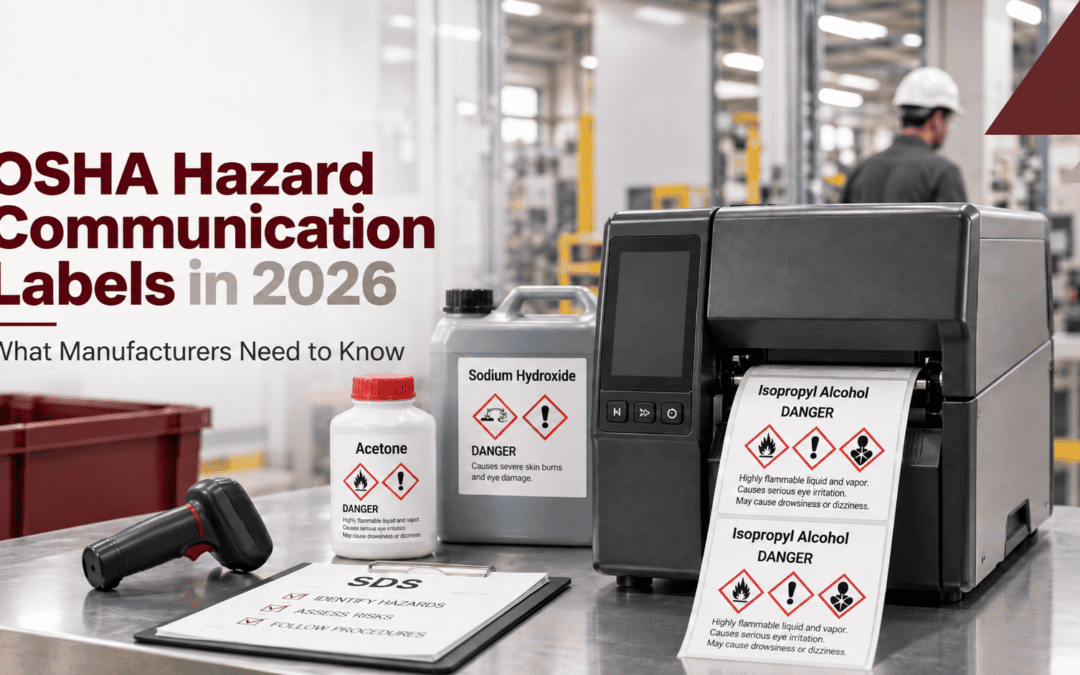
Manufacturers deal with labels every day—from product identification and inventory tracking to shipping, safety and regulatory compliance. But in 2026, chemical labeling deserves another look.
OSHA updated its Hazard Communication Standard (HCS) to more closely align with the United Nations’ Globally Harmonized System of Classification and Labelling of Chemicals, primarily GHS Revision 7. The changes affect chemical classification, labels, Safety Data Sheets (SDSs), small-container labeling and how certain hazards are communicated throughout the supply chain.
For manufacturers that produce, import, distribute or use hazardous chemicals, some compliance dates have already arrived while others are approaching.
That makes now a good time to review not only the information appearing on your labels, but also the systems and industrial printers responsible for producing them.
What Changed with OSHA’s Hazard Communication Standard?
OSHA’s Hazard Communication Standard is designed to make sure workers receive understandable information about hazardous chemicals they may encounter in the workplace.
Chemical manufacturers and importers are responsible for evaluating chemical hazards and communicating that information through labels and Safety Data Sheets. Employers that use hazardous chemicals must maintain appropriate labels and SDSs and provide employees with hazard communication information and training.
OSHA’s latest HCS revisions were published in 2024 and became effective July 19, 2024. OSHA subsequently extended the compliance dates by four months in January 2026.
Some of the more significant updates involve:
- Revised hazard classifications for certain chemicals;
- New or revised classifications involving aerosols, desensitized explosives and flammable gases;
- Updated rules for small-container labeling;
- Updated requirements involving chemicals that have already been released for shipment;
- Changes affecting Safety Data Sheets;
- Additional provisions related to bulk shipments;
- And changes designed to improve how hazard information reaches downstream users.
For manufacturers, the changes can affect much more than a regulatory binder. They can eventually affect the actual information your production labeling system needs to print.
OSHA Hazard Communication Deadlines Manufacturers Should Know
The most important thing to understand is that there is not one single 2026 deadline for everyone. OSHA’s current compliance schedule separates substances from mixtures and also gives employers additional time to update workplace programs after manufacturers, importers and distributors comply.
For substances
Chemical manufacturers, importers and distributors evaluating substances were required to comply with the modified HCS provisions by: May 19, 2026. Employers have until: November 20, 2026, to update alternative workplace labeling, their written Hazard Communication program and any additional employee training that is necessary because of newly identified hazards.
So, as of fall 2026, the manufacturer deadline for substances has already passed, while the November employer deadline is quickly approaching.
For mixtures
OSHA provides a longer transition period for mixtures. Chemical manufacturers, importers and distributors evaluating mixtures must comply with the modified provisions by: November 19, 2027. Employers then have until: May 19, 2028, to make corresponding workplace-label, Hazard Communication program and training updates as necessary. For facilities dealing with both substances and mixtures, this staggered timeline makes it especially important to understand which products fall under which compliance date.
What Information Is Required on an OSHA Hazard Communication Label?
For shipped containers of hazardous chemicals covered by OSHA’s Hazard Communication Standard, required label information generally includes:
- Product identifier
- Signal word
- Hazard statement or statements
- Hazard pictogram or pictograms
- Precautionary statement or statements
- Name, U.S. address and U.S. telephone number of the chemical manufacturer, importer or other responsible party
The label elements are intended to work together so workers can quickly identify the chemical and understand the nature and severity of its hazards. That makes print quality important. Small type, damaged labels, incomplete print jobs or poorly reproduced hazard pictograms can create problems in a manufacturing environment where employees need to interpret information quickly.
However, it is important to distinguish between the content required by OSHA and the equipment used to produce the label. An industrial label printer does not make a label OSHA compliant by itself. The organization responsible for the chemical must determine the correct classification, wording, pictograms and other required label information. The printing system’s job is to reproduce that approved information consistently and legibly.
Small Chemical Containers Have New Labeling Provisions
One of the more practical changes in the updated standard involves small containers. Trying to fit extensive hazard information onto a tiny vial or container can make the label difficult to read. OSHA’s updated HCS now provides specific accommodations for these situations.
When a manufacturer, importer or distributor can demonstrate that it is not feasible to use a pull-out label, fold-back label or tag containing the complete information, containers of 100 milliliters or less may use a reduced label containing, at minimum:
- Product identifier;
- Required pictogram or pictograms;
- Signal word;
- Chemical manufacturer’s name and phone number; and
- A statement explaining that the complete hazard label information appears on the immediate outer package.
The immediate outer package still has to provide the complete required label information. OSHA goes even further for containers of 3 milliliters or less. Where the responsible company can demonstrate that a label would interfere with normal use of the container, the container may bear only the product identifier, although the complete information is still required on the immediate outer packaging.
For manufacturers working with laboratory chemicals, specialty chemicals, samples or other small containers, these provisions are particularly worth reviewing.
Manufacturers Should Also Pay Attention to Combustible Dust Hazards
The updated HCS isn’t only about drums, bottles and chemical containers. Manufacturing operations involving materials that can generate combustible dust should pay particular attention to how downstream hazards are communicated.
OSHA’s updated requirements address chemicals that may create a combustible dust hazard during normal downstream processing or handling. OSHA’s Appendix C includes specific hazard communication provisions for combustible dust, including circumstances where material is shipped in a form that is not yet dust but may create hazardous dust during downstream processing.
That could be relevant in operations involving materials that are cut, ground, milled, sanded or otherwise processed into smaller particles.
Manufacturers should therefore look beyond the condition of a material when it leaves their facility and review whether normal downstream use changes the hazards that need to be communicated.
What About Chemicals Already Packaged for Shipment?
Another noteworthy change deals with chemicals that have already been packaged and labeled for future distribution. Under the updated rule, when significant new hazard information becomes available, companies generally must revise chemical labels. But OSHA provides additional flexibility for chemicals that have already been released for shipment.
Rather than opening packaged products, breaking down pallets and relabeling every container, manufacturers, importers or distributors may leave those containers as they are in certain circumstances. If they choose not to physically relabel them, however, the updated label must be provided for each individual container with the shipment. For manufacturers with long production runs or substantial finished-goods inventory, this change can be operationally significant.
Don’t Review Labels Without Reviewing Your Safety Data Sheets
Labels are only one part of Hazard Communication. Safety Data Sheets remain a central part of OSHA’s HCS, and chemical manufacturers and importers are required to develop or obtain an SDS for hazardous chemicals they produce or import. Employers are required to have an SDS available for hazardous chemicals used in the workplace.
Because hazard classifications and label information are connected to SDS information, manufacturers preparing for HCS changes should review the two together. A label should not be treated as an isolated graphic file sitting on a production computer.
Think of the process as a connected information workflow:
Hazard classification → SDS → approved label information → label software → industrial printer → finished label
A problem anywhere in that chain can create rework, production delays or inconsistent labeling.
What Manufacturers Should Review Before the Next OSHA Deadline
If your facility produces or uses hazardous chemicals, now is a good time to examine your entire labeling workflow.
- Start by identifying which products are substances and which are mixtures, so you know which compliance dates apply.
- Then review your current SDSs and hazard classifications and determine whether any changes require corresponding updates to shipped container or workplace labels.
- Manufacturers should also look at whether they produce small containers covered by OSHA’s updated labeling provisions, whether downstream processing can create hazards such as combustible dust, and whether existing packaged inventory could be affected by the released-for-shipment provisions.
- Finally, look at the physical labeling process itself.
Are your printers consistently producing readable text and hazard pictograms? Can your current equipment handle the label dimensions and media required by your operation? Are label templates centrally controlled? Are operators using the current version of each approved label? Are aging printers causing reprints or production interruptions?
Compliance requirements may determine what needs to appear on a label. Your labeling infrastructure determines whether you can reliably produce that label when production needs it.
Choosing an Industrial Printer for Chemical and Compliance Labels
Manufacturing label environments can be demanding. Labels may need to remain readable while exposed to handling, storage, moisture, abrasion, temperature changes or other environmental conditions. Some applications require extremely small text or graphics, while others require high production speeds. That is why choosing an industrial label printer should involve more than comparing print speed.
Manufacturers should consider:
- label dimensions;
- required print resolution;
- direct thermal versus thermal-transfer printing;
- expected label life;
- label and ribbon compatibility;
- production volume;
- barcode requirements;
- printer software and language compatibility;
- environmental conditions;
- and future labeling requirements.
For durable applications, thermal-transfer printing can be an option because the ribbon transfers the printed image onto the label material. The specific label stock, ribbon and adhesive still need to be matched to the application and operating environment.
Some operations may also benefit from higher-resolution printers when labels contain small text, compact barcodes or detailed graphics.
OSHA Compliance Is About Information—Reliable Printing Helps Deliver It
OSHA’s updated Hazard Communication Standard is ultimately about communicating hazards clearly to the people who work with chemicals. But that information still has to make its way from an SDS or label-management system onto a physical container.
For manufacturers producing hundreds or thousands of labels, unreliable printing can become a production issue just as quickly as it becomes a labeling issue.
DDL Business Systems works with manufacturers throughout Virginia, Northern Virginia and the Shenandoah Valley to evaluate industrial thermal-printing environments, including printer hardware, print volume, label dimensions, resolution requirements, labels and ribbons.
DDL can help determine whether your existing industrial label printers are capable of supporting your labeling workflow or whether aging equipment is creating unnecessary downtime and reprints.
Preparing for changing industrial labeling requirements?
Learn more about DDL’s Toshiba BX400 industrial label printers, thermal-transfer labels and ribbons, or schedule an industrial printing assessment to review your current labeling environment.
This article is intended for general informational purposes and is not legal, regulatory or safety advice. Organizations should review the current OSHA Hazard Communication Standard and consult qualified safety or compliance professionals to determine the requirements that apply to their specific chemicals and operations.
Recent Comments